Capability at a competitive point of entry
Internationally proven operations show that Portugal can host global manufacturing, engineering, R&D, services and infrastructure—not merely local sales offices.

A country business case built on evidence, not promotion: macro resilience, foreign capital, export capability, industrial depth, innovation, talent, energy and the execution constraints that determine real returns.
Test an investment thesis
Portugal merits serious consideration when an investor can convert its EU and euro-area position, Atlantic connectivity, export clusters, renewable electricity, engineering capability and international attractiveness into a sector-specific advantage. It is less compelling when the thesis depends only on cheap labour, a large domestic market, automatic incentives or frictionless permitting.
Internationally proven operations show that Portugal can host global manufacturing, engineering, R&D, services and infrastructure—not merely local sales offices.
Talent, housing, power, land, licensing, suppliers and incentives vary materially by region. The national case is only the opening hypothesis.
Portugal has stronger capabilities than its productivity, firm investment and venture-capital conversion suggest. Disciplined capital and execution can exploit that gap.
Latest available values, each with period and source. These indicators establish relevance; they do not replace project-level feasibility.
2025
S012025
S01End-2025 · 70% of GDP
S032024 · goods + services
S06Gross consumption · 2024
S082025 · EU average €34.9
S092024
S06TEU · 2024 · +16% YoY
S17Read carefully. FDI stock is a balance-sheet position; AICEP-contracted projects are a project pipeline; balance-of-payments FDI transactions are annual flows. They measure different things and are not added together.
The IMF describes strong performance and faster growth than the euro-area average after the pandemic. The analytical point is resilience: repeated fiscal surpluses, falling public debt, a current-account surplus and a stable banking system—alongside slower medium-term growth and external risk.
* IMF projection. Values and estimates may be revised.
* IMF projection. Values and estimates may be revised.
* IMF projection, supported by accelerated EU-fund execution. The IMF also warns that external weakness, tariffs, inflation, ageing and low productivity can reduce the upside. Read the IMF assessment
At end-2025, inward FDI stock stood at €213.7bn—70% of GDP. That scale makes foreign capital part of Portugal’s operating system. But one-year flows are volatile, and productive contribution differs materially by sector.
Q1 is shown for recency, not as a like-for-like annual comparison. Flows are subject to revision.
Banco de Portugal’s evidence supports a sharper policy and investor thesis: the highest-value FDI adds productive capacity, exports, technology, qualified employment, local suppliers and reinvestment. Capital alone is not the outcome.
Open the underlying analysisPortugal does not need capital at any cost. It needs investment that compounds capability and retains value in the economy.NAUPT inference from Banco de Portugal evidence
Portugal sits inside four systems that overlap without being equivalent: the EU single market, Atlantic trade and data geography, the nine-state CPLP and the five PALOP economies. Only the EU is an integrated single market; every other advantage remains connection- and execution-dependent.
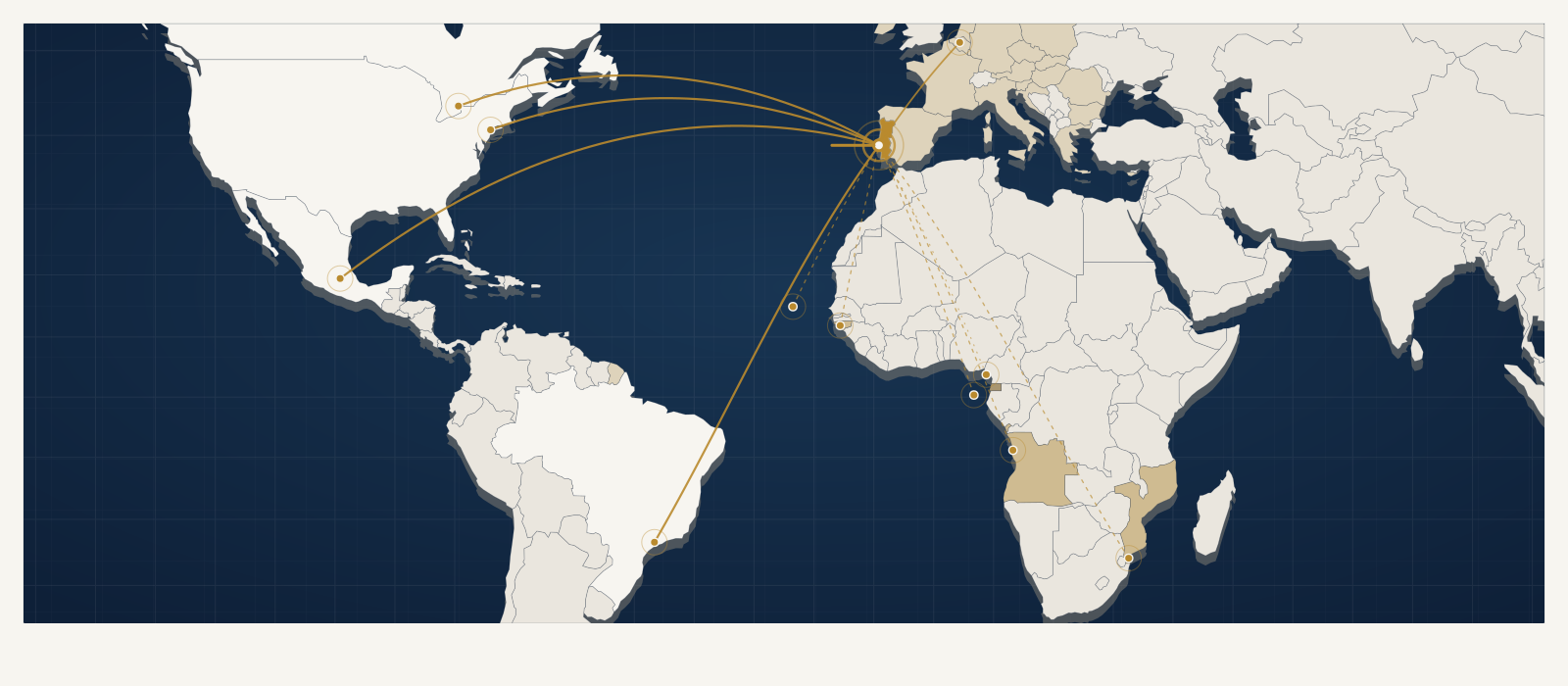
Reading note. 2024 population indicates human scale, not addressable demand. “Atlantic reference markets” is a NAUPT analytical grouping, not a treaty bloc. CPLP population counts residents, not Portuguese speakers. Categories overlap and must not be added together.
Portugal is part of the EU single market and euro area. This is the legally integrated layer: common market rules, Treaty freedoms and a shared currency across euro-area members. Sector regulation, competition, licensing and national implementation still require verification.
Institutional system · integrated marketCanada and the United States anchor the North Atlantic relationship; Brazil anchors the South Atlantic and the largest Lusophone economy. Mexico remains economically relevant within the wider North American system, but is not presented as a direct Portuguese Atlantic corridor. Ports, TEN-T links and subsea cables make geography operational.
Geographic system · execution dependentThe CPLP connects Angola, Brazil, Cabo Verde, Guinea-Bissau, Equatorial Guinea, Mozambique, Portugal, São Tomé and Príncipe and Timor-Leste. It is a multilateral cooperation community—not a customs union, common market or single regulatory area.
Cooperation system · not a single marketPALOP refers to Angola, Cabo Verde, Guinea-Bissau, Mozambique and São Tomé and Príncipe. Shared official language and cooperation history do not make them one market: currency, scale, legal practice, FX exposure, infrastructure and political economy differ materially.
Analytical group · five jurisdictionsPALOP is a five-country subset of the wider nine-state CPLP. Timor-Leste is a CPLP member in Asia and is intentionally shown outside the Atlantic map frame.
Portugal can be a credible European base with Atlantic reach and Lusophone relationships. It is not automatically the right platform for every investor, sector or destination market.

Averages conceal the decision. Industrial ecosystems, talent, property, utilities, incentives, suppliers and affordability are regional—and often sub-regional.
Mobility · mechanical engineering · textiles · footwear · furniture · software
Moulds · ceramics · mobility · health · forest industries · industrial engineering
Finance · GBS · digital · life sciences · mobility · creative industries
Port logistics · batteries · data centres · hydrogen · agrifood · aerospace
Tourism · hospitality · health · marine economy · real assets
Space · ocean · tourism · international services · renewable systems
AICEP maps ten national clusters, spanning aerospace, agrifood, blue economy, construction, cultural industries, health, ICT and shared services, lifestyle, mechanical engineering and mobility.
Explore the official cluster architecturePortugal is a Moderate Innovator at 93.2% of the EU average in the European Innovation Scoreboard 2026. The useful story lies underneath: research, public support and digitalisation outperform the conversion into firm investment, venture capital, patents and productivity.
For international corporates, PE, family offices and strategic investors, the gap can create entry opportunities: acquire under-scaled firms, professionalise management, add technology, consolidate suppliers, internationalise sales or finance the step from technical proof to industrial scale.
Portugal’s policy ecosystem count for 2025, with roughly 28,000 employees and €2.856bn turnover.
S12Dealroom’s live investor-market snapshot: 907 tracked startups and seven $1bn+ outcomes.
S14Dealroom ecosystem estimate. The metric is market-based and can move with valuations and methodology.
S14Banco Português de Fomento allocation spanning pre-seed through Series C and scale-up.
S16The 5,091 and 907 counts are not contradictory: Startup Portugal and Dealroom use different inclusion rules. We show both precisely because serious analysis must preserve definitions.
Public and institutional capital can de-risk innovation, energy, infrastructure and regional investment. It must enhance a viable investment case—not become the case.
Portugal’s 2021–2027 cohesion envelope under the jobs-and-growth objective.
S07Expected by the EIB to mobilise approximately €12bn; close to €500m was directed to innovation.
S15Contracted project value in 2025, associated by Government with 6,600 proposed jobs—not the same measure as FDI inflow.
S05Programme allocation; investment remains subject to intermediary, stage, eligibility and commercial assessment.
S16Model the project before the incentive. Confirm eligible expenditure, incentive effect, state-aid limits, application timing, financing bridge, milestones, clawbacks and audit evidence before including support in the base case.
Long-duration international operators demonstrate that Portugal can support industrial production, engineering, shared services, R&D and globally integrated operations.
240,400 vehicles and 4,803 employees in 2025; approximately 4.5% of Portuguese goods exports.
Primary sourceMore than 5,900 people and €2.2bn in Portugal sales in 2025; export-oriented mobility and home-comfort competence centres.
Primary sourceAround €1bn cumulatively invested in Lousado; 18m-tyre annual capacity and roughly 2,800 people.
Primary sourceIndustrial, engineering and global-business-service operations, with more than 1,400 direct employees in Portugal.
Primary sourceMore than 9,700 people and eleven international excellence centres; present in Portugal since 1985.
Primary sourceThirty-five years in Portugal; announced more than US$10bn for AI infrastructure in Sines from 2026.
Primary sourceMore than US$10bn announced from 2026 for AI infrastructure with Nscale, NVIDIA and Start Campus; announcement, not yet executed capex.
S24€2.065bn contracted battery project and 1,800 proposed jobs, including 497 highly qualified roles.
S25Airbus–Critical Software joint venture launching with 120 people and targeting 300 by end-2028.
S261.2 GW planned AI-ready data-campus capacity, developed in phases; delivery and power assumptions require project-level verification.
S30Portugal’s education profile has improved rapidly, and international student participation is significant. At the same time, ageing, skills mismatches, housing and uneven regional depth can constrain delivery.
Up from 38% in 2019. Portugal also had 13.3% international or foreign students in tertiary education in 2023, compared with 7.4% across the OECD.
OECD education profileof 2024 graduates were in engineering, mathematics, sciences or technologies, based on AICEP/DGEEC data.
S06projected decline in working-age population over the next two decades—the strategic case for productivity, immigration and retention.
S02unemployment in 2025: evidence of labour-market strength, but also of tighter recruitment conditions in specific occupations.
S01A credible country thesis must identify where value can leak, what can delay execution and which risks Portugal cannot solve for a particular investor.
Labour productivity remains about 17% below the OECD average. Portugal cannot rely on lower labour cost alone.
S02Design technology, process, management systems and a quantified value-creation plan before committing capital.
Around 40% of business-economy employment sits in micro firms, constraining scale and management depth.
S02Use sector mapping, proprietary origination, buy-and-build logic, governance upgrades and supplier consolidation.
The OECD identifies complex corporate taxation and high compliance costs; the IMF calls for streamlined bureaucracy.
S02Build the regulatory route map, permit critical path, responsibilities, decision log and institutional interface at the start.
The working-age population may decline 16% over two decades; sector-specific shortages already constrain firms.
S02Model skills by location, recruitment ramp, education partnerships, immigration, housing and retention before site selection.
Housing prices have risen faster than disposable income, with constrained supply in the most attractive locations.
S02Include housing availability, commute, relocation and total employee cost in the location scorecard—not as an afterthought.
Portugal scores strongly on public R&D support but materially below the EU on VC expenditure and firm investment.
S13Engineer the capital stack, milestone the raise, test investor fit and connect incentives to a viable—not subsidy-dependent—case.
FDI companies generate a disproportionate share of exports, but are also import-intensive and remit income abroad.
S04Measure local sourcing, technology transfer, export intensity, qualified employment, reinvestment and value retained in Portugal.
Grid, rail, port and permitting capacity can differ between announced potential and capacity available on the project date.
S02Verify connection rights, operational dates, property title, utilities, permits and contingency routes before asset commitment.
The investor decides. NAUPT’s role is to make both the GO and NO-GO case explicit before sunk cost and institutional momentum distort the decision.
NAUPT tests Portugal against real alternatives, then converts the answer into an accountable path across Acquire, Build, Invest or Develop / Own.
This page is decision support, not legal, tax or investment advice. Project announcements are labelled as such; incentives and forecasts remain conditional.
IMF, OECD, European Commission, Eurostat, Banco de Portugal, Government, AICEP and company primary disclosures are preferred.
Every metric carries its period and unit. Flows, stocks, project values and financing allocations are kept separate.
External evidence supports the fact. NAUPT’s interpretation explains why it may matter. Project conclusions require mandate-level work.
Evidence base reviewed 18 August 2026. Macro, FDI, incentives and major project claims should be revalidated before a decision.
Concise answers for investors beginning to assess Portugal.
Portugal can combine EU and euro-area access, Atlantic connectivity, export-oriented industrial and service clusters, renewable electricity, competitive operating costs and quality of place. The case is strongest when these assets match a specific sector, route and location.
No. Labour costs remain below the EU average, but wages are rising and productivity remains a constraint. The defendable thesis is value-for-capability: engineering, export platforms, specialist clusters, renewable power and the ability to attract international talent.
Mobility and advanced manufacturing, mechanical engineering, ICT and global business services, energy-transition value chains, aerospace and defence, health and life sciences, agrifood, blue economy, tourism and selected real assets all have evidence of cluster depth. Fit remains project-specific.
Productivity, fragmented business scale, administrative complexity, skills shortages, housing pressure, underdeveloped scale-up capital and uncertainty around infrastructure or licensing delivery. These risks are manageable only when tested early and owned through execution.
NAUPT moves from country thesis to sector thesis, route selection, regional and site comparison, capital and incentive architecture, risk-adjusted business case, due diligence and accountable execution. The investor retains the decision.
Bring the objective, route, sector, timing and constraints. NAUPT will test Portugal against alternatives, identify the critical unknowns and define the work required before any mandate is confirmed.
Discuss a confidential mandate